U.S. Intervention in the Japanese Yen: Why Washington Stepped In and What It Means for USD/JPY

The Japanese yen has become one of the most closely watched currencies in global foreign exchange markets in 2026. After the USD/JPY exchange rate climbed toward levels not seen in decades, Japanese authorities took action to support the yen. What made the latest episode particularly significant was Washington's decision to participate in a coordinated yen-buying operation with Tokyo.
The move represents a major development in global currency policy. It also raises an important question for forex traders: Can U.S.-Japan intervention create a lasting yen recovery, or will interest-rate differentials continue to push USD/JPY higher?
As of August 2026, the answer remains uncertain. The yen initially strengthened sharply after the intervention, but USD/JPY has subsequently moved back toward 159, showing that intervention can change market dynamics without necessarily changing the underlying fundamentals.
This article examines the latest Yen Intervention FX developments, why Washington stepped in, the potential Yen Market Impact FX, and what traders should watch in the USD JPY Outlook 2026.
What Is Yen Intervention?
Foreign-exchange intervention occurs when a government or central bank enters the currency market to influence the exchange rate.
When Japan wants to strengthen the yen, its authorities generally sell U.S. dollars and buy Japanese yen. This creates additional demand for JPY and increases selling pressure on USD/JPY.
The objective is not necessarily to establish a specific exchange rate. Instead, intervention is typically intended to counter excessive volatility, disorderly movements, or speculative pressure.
Japan's Ministry of Finance explains that intervention can be used when exchange rates move significantly or diverge from economic fundamentals in a destabilizing manner.
For traders following the JPY Forex Guide 2026, this distinction is important. Intervention does not automatically mean that the yen has entered a long-term bullish trend. It can instead represent an attempt to slow the speed of depreciation and give policymakers time to address the underlying causes.
Why Did Washington Step In?
The 2026 intervention was unusual because the United States participated alongside Japan.
According to Reuters, the U.S. Treasury intervened in the yen market in late July, with the Federal Reserve Bank of New York executing transactions on behalf of the Treasury. The operation involved selling euros to purchase yen rather than simply selling dollars.
The move followed an extreme weakening of the yen. USD/JPY reached approximately 163.99 on July 23, a level that represented the weakest yen in roughly four decades.
There were several reasons Washington had an interest in the situation.
1. Preventing excessive currency volatility
A rapidly weakening yen can create instability beyond Japan.
The yen is one of the world's most important funding currencies. Large numbers of investors borrow yen at relatively low rates and invest in higher-yielding assets elsewhere.
A disorderly yen decline can therefore affect global carry trades, bond markets, equities and other currencies.
Treasury Secretary Scott Bessent has also linked Washington's participation to concerns about broader Asian financial instability and lessons from the Asian financial crisis of the 1990s.
2. Protecting financial-market stability
Japan is one of the world's largest holders of U.S. Treasury securities.
One concern surrounding yen intervention is that Japan could potentially need to sell dollar assets to obtain the dollars required for currency operations.
Reuters reported that the U.S. intervention was partly designed to reduce potential disruption to U.S. Treasury markets. The use of euros rather than dollars was particularly notable because it allowed Washington to buy yen without directly selling U.S. Treasuries in the same way Japan might.
3. Addressing excessive yen depreciation
A weak yen increases the cost of imported goods and energy for Japan.
That matters because Japan relies heavily on imports for energy and raw materials. A sharp currency decline can therefore contribute to inflation even when domestic demand is relatively weak.
The pressure becomes particularly important when energy prices are rising.
4. Supporting the U.S.-Japan economic relationship
Currency policy has become an increasingly important part of U.S.-Japan economic discussions.
The two governments have maintained close communication over foreign-exchange markets, and previous U.S.-Japan statements emphasized cooperation on financial stability and orderly currency markets.
The 2026 intervention takes that cooperation considerably further.
How Did the Intervention Affect USD/JPY?
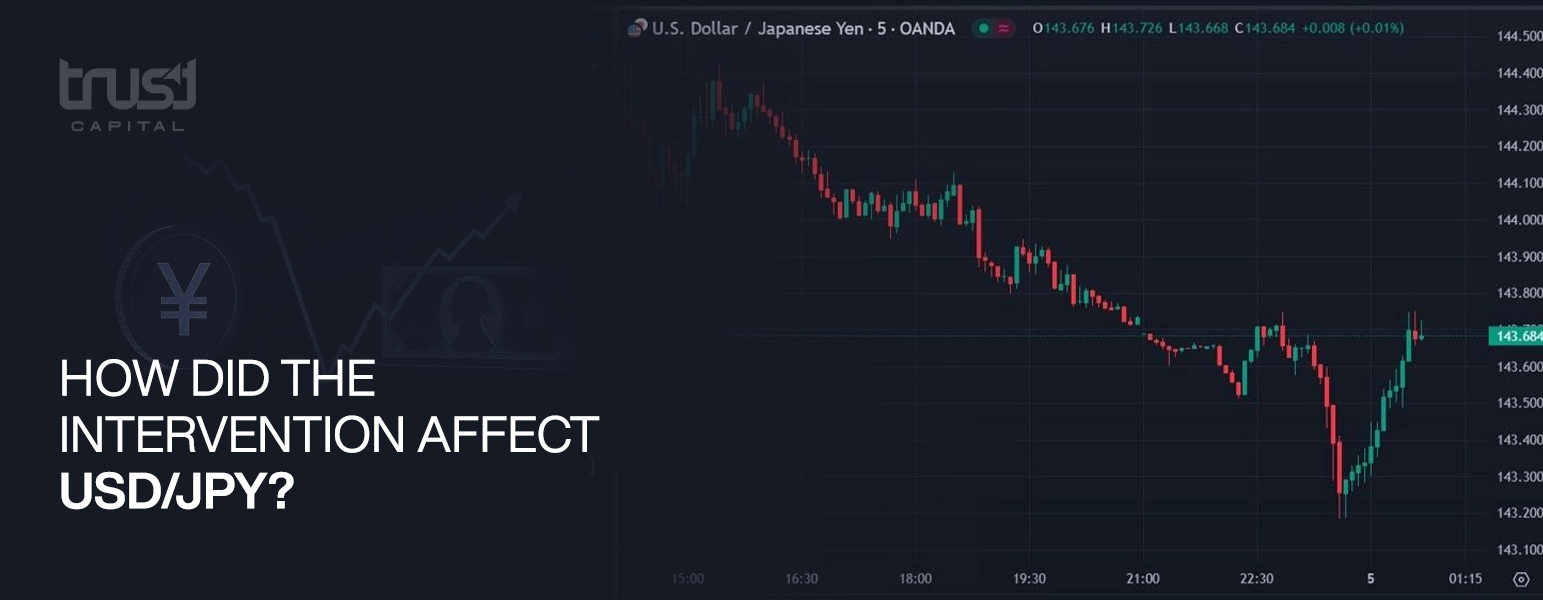
The immediate market reaction was significant.
Following the U.S.-Japan operation, the yen strengthened and USD/JPY fell. Reuters reported that USD/JPY moved from around 158.9 to approximately 157.6 during the intervention.
However, the longer-term reaction has been less straightforward.
By August 12, USD/JPY was back around 159.4, demonstrating that intervention alone has not eliminated the forces supporting the dollar.
This is one of the most important lessons for traders studying the Yen Market Outlook.
Intervention can change price action quickly—but fundamentals still matter.
If the interest-rate differential between the United States and Japan remains attractive to investors, traders may continue buying dollars against the yen.
That creates a fundamental challenge for policymakers.
The Interest-Rate Problem Behind USD/JPY
Currency intervention addresses the exchange rate directly, but interest-rate policy affects the incentives behind capital flows.
For much of the recent period, U.S. interest rates have been substantially higher than Japanese rates.
That creates an incentive for investors to hold dollar-denominated assets while funding positions in yen.
This is commonly referred to as the yen carry trade.
If investors believe the U.S.-Japan interest-rate differential will remain wide, they may continue to sell yen even after government intervention.
That is why the Yen Trading Outlook cannot focus solely on intervention headlines.
Traders should also monitor:
-
Federal Reserve interest-rate expectations
-
Bank of Japan policy
-
U.S. Treasury yields
-
Japanese Government Bond yields
-
U.S. inflation
-
Japanese inflation
-
Energy prices
-
Global risk sentiment
-
Yen speculative positioning
-
Official intervention warnings
The Bank of Japan Is Now Critical
Intervention becomes more powerful when it is supported by monetary policy.
Reuters reported that the Bank of Japan's June 2026 rate increase brought its policy rate to 1%, while U.S. Treasury Secretary Scott Bessent has argued that additional Japanese rate increases could complement currency intervention.
This creates a potentially important policy combination:
Japan buys yen + BOJ raises rates + U.S. supports intervention = stronger pressure against USD/JPY.
But if the BOJ remains cautious while the Federal Reserve maintains relatively restrictive policy, the fundamental incentive to hold dollars could remain strong.
For traders, this makes future BOJ meetings particularly important in the JPY FX Outlook 2026.
What Does This Mean for USD/JPY Traders?
The latest intervention changes the risk profile of USD/JPY.
Before intervention, traders could focus primarily on economic data, interest rates and technical levels.
Now there is an additional variable:
Policy risk.
A trader holding a large short-yen position must consider the possibility that another intervention could produce a rapid move of several yen.
This can happen even when the trader's broader fundamental thesis remains correct.
For example, a trader may believe that USD/JPY should eventually rise because U.S. yields remain higher. But if Japan and the U.S. suddenly intervene, USD/JPY could fall sharply before fundamentals regain control.
That makes risk management particularly important.
Key USD/JPY Scenarios for 2026
The USD JPY Outlook 2026 can broadly be divided into three scenarios.
Scenario 1: Further intervention strengthens the yen
If USD/JPY approaches or exceeds previous extreme levels, Japanese authorities could consider additional action.
Japanese officials have already indicated that they remain in close communication with Washington and are prepared to respond if necessary.
Under this scenario:
-
USD/JPY could experience sharp declines
-
JPY volatility could increase
-
Carry trades could unwind
-
Yen buying could accelerate
-
Traders may become reluctant to hold large USD/JPY long positions
This would be the most bullish scenario for the yen.
Scenario 2: BOJ tightening supports the yen
A more sustainable yen recovery could occur if intervention is combined with higher Japanese interest rates.
If the BOJ continues tightening while the Federal Reserve moves toward lower rates, the U.S.-Japan yield differential could narrow.
That would reduce one of the major structural reasons for yen weakness.
This scenario would potentially create a stronger and more durable Yen FX Trends 2026 reversal.
Scenario 3: Fundamentals overpower intervention
The third possibility is that intervention provides only temporary relief.
This is already partly visible in August. Despite the previous joint intervention, USD/JPY returned toward 159.
If U.S. yields remain high, the Fed remains restrictive and Japanese rates remain comparatively low, investors may eventually resume buying dollars.
In that case, intervention could become a recurring feature of the market rather than a permanent solution.
The Role of U.S. Economic Data

The dollar side of USD/JPY remains just as important as Japanese policy.
Recent U.S. economic data have already produced significant moves.
A weaker-than-expected July employment report caused U.S. Treasury yields to fall and helped USD/JPY decline sharply toward the 156–157 area. Reuters reported that July payrolls fell by 23,000, compared with expectations for an increase of approximately 80,000.
This illustrates a critical point:
USD/JPY does not move only because of intervention.
Economic data can sometimes produce larger and more sustainable moves than government currency operations.
For the Top USD JPY Trends, traders should therefore watch U.S. CPI, employment data, Fed expectations and Treasury yields alongside Japanese policy announcements.
What Traders Should Watch Next
The next phase of the market could be driven by five major variables.
1. USD/JPY intervention thresholds
There is no publicly guaranteed level at which Japan will intervene.
However, extreme moves and rapid depreciation tend to increase intervention risk.
Traders should pay attention to official comments from Japan's Ministry of Finance and signs of increased communication between Tokyo and Washington.
2. Bank of Japan policy
A BOJ rate hike would potentially strengthen the yen by reducing the interest-rate differential.
The market is therefore closely watching whether policymakers follow intervention with further monetary tightening.
3. Federal Reserve policy
If U.S. inflation remains high, the Federal Reserve could maintain higher rates for longer.
That would support the dollar.
Conversely, weaker inflation and labor-market conditions could increase expectations for lower U.S. rates, potentially weakening USD/JPY.
4. U.S. Treasury yields
USD/JPY historically reacts strongly to changes in U.S. yields.
Higher Treasury yields can increase the attractiveness of dollar assets, while falling yields can reduce the dollar's advantage.
This makes the U.S. bond market an important part of any Best USD JPY Guide.
5. Energy prices
Energy prices are particularly important for Japan because the country depends heavily on imported energy.
Higher oil prices can increase Japan's import costs and put additional pressure on the yen.
This means geopolitical developments can influence USD/JPY even when they have nothing directly to do with Japanese monetary policy.
Yen Market Outlook: What Comes Next?
The Yen Market Outlook has become more complicated after the historic U.S.-Japan cooperation.
The immediate objective of intervention appears to have been achieved: the yen strengthened sharply and speculative positioning became more cautious.
But the subsequent recovery in USD/JPY shows that the market still believes the yen faces significant fundamental headwinds.
The biggest question for the remainder of 2026 is therefore not simply:
"Will Japan intervene again?"
The more important question is:
"Will intervention be supported by monetary-policy changes?"
If the BOJ continues tightening and U.S. rates move lower, intervention could mark the beginning of a larger yen recovery.
If the opposite occurs, intervention may simply create temporary declines in USD/JPY that eventually attract new dollar buyers.
Yen Intervention FX: What Traders Should Remember
The latest episode offers several important lessons for forex traders.
First, government intervention can produce extremely rapid price movements.
Second, intervention does not necessarily reverse long-term economic fundamentals.
Third, the Bank of Japan and Federal Reserve remain critical to the medium-term direction of USD/JPY.
Fourth, U.S. participation increases the potential credibility of future intervention.
And fifth, traders should treat intervention risk as a fundamental market variable rather than simply a headline event.
Top JPY Market News and Top Yen Market News to Monitor
For traders looking for the Top JPY Market News, Top Yen Market News, and Best Yen Forex News, the most important developments are likely to come from:
-
Bank of Japan interest-rate decisions
-
U.S. Federal Reserve meetings
-
U.S. CPI and employment reports
-
Japanese inflation data
-
U.S. Treasury yields
-
Japanese Government Bond yields
-
Ministry of Finance intervention warnings
-
U.S. Treasury comments
-
USD/JPY positioning data
-
Oil and energy prices
-
Major geopolitical developments
These indicators provide a more complete picture than following the USD/JPY exchange rate alone.
Best Yen FX Trends for Traders
The Best Yen FX Trends in 2026 may emerge from the interaction between policy intervention and interest-rate expectations.
A sustained yen rally would be more convincing if USD/JPY declines while Japanese yields rise and U.S. yields fall.
Conversely, if USD/JPY rises despite intervention warnings, it would indicate that the market continues to believe the dollar's fundamental advantage is stronger than policymakers' ability to resist yen depreciation.
This relationship between price, yields and policy is one of the most useful concepts in any Top JPY Forex Guide.
Final Thoughts
The 2026 U.S.-Japan yen intervention marks an important change in the foreign-exchange landscape.
Washington's participation demonstrates that extreme yen weakness is no longer viewed purely as a Japanese problem. The potential spillovers into Asian currencies, global carry trades, U.S. Treasury markets and financial stability have given the United States a greater incentive to participate.
Yet intervention is not a magic solution.
The yen's longer-term direction will depend on whether policymakers can change the underlying incentives that have encouraged investors to sell JPY. The BOJ's interest-rate path, Federal Reserve policy, U.S.-Japan yield differentials and global risk sentiment will remain central to the JPY Forex Guide 2026 and the broader JPY FX Outlook 2026.
For USD/JPY traders, the key takeaway is simple: intervention has increased downside risk, but it has not eliminated the fundamental forces supporting the dollar.
That makes the remainder of 2026 potentially one of the most volatile and policy-sensitive periods for USD/JPY in years.
Disclaimer: This article is for educational and informational purposes only and should not be considered investment, trading, or financial advice. Forex and CFD trading involves substantial risk, and past market behavior does not guarantee future results.