How OPEC Decisions Influence Global Oil Prices.
Introduction: Why OPEC Decisions Matter to Global Oil Prices
Oil prices are influenced by several factors, including global demand, geopolitical tensions, economic growth, inventory levels, and production costs. However, one of the most important forces shaping the international energy market is the Organization of the Petroleum Exporting Countries (OPEC) and its cooperation with non-OPEC oil-producing nations through the OPEC+ alliance.
OPEC decisions can influence how much crude oil reaches the global market, affecting the balance between supply and demand. When participating producers reduce output, oil prices may rise if demand remains strong. Conversely, production increases can put downward pressure on prices when the market already has sufficient supply.
Understanding the OPEC oil price impact is particularly important for energy companies, investors, businesses, and traders who follow Brent crude and West Texas Intermediate (WTI). Production announcements can influence market sentiment quickly, sometimes causing sharp price movements even before the full impact of a decision becomes visible in physical oil supplies.
In 2026, changing demand expectations, production adjustments, and geopolitical risks have made oil supply and pricing especially important topics for market participants. Learning how OPEC decisions work can help readers better understand oil supply price trends, identify important market developments, and evaluate the factors that could shape crude oil prices in the months ahead.
1. What Is OPEC and How Does It Influence the Oil Market?
OPEC is an intergovernmental organization comprising major oil-producing countries. Its members coordinate discussions about petroleum market conditions, production policies, and the longer-term stability of the oil industry.
OPEC's decisions can influence global oil prices because its members collectively produce a substantial amount of the world's crude oil. Through production targets and policy announcements, the organization can affect expectations about the quantity of oil available to refiners and consumers.
OPEC+ extends this cooperation to participating non-OPEC producers, including Russia. This broader group can have an even greater influence on market expectations because its decisions involve additional sources of oil production.
The group's market influence generally operates through three main channels:
-
Production adjustments: Changes in planned output can tighten or loosen global oil supply.
-
Market expectations: Traders may adjust prices immediately when an announcement changes expectations about future availability.
-
Coordination among producers: Cooperation can influence how much oil participating countries collectively intend to produce.
However, OPEC does not have complete control over global oil prices. Production from countries outside the alliance, economic conditions, inventory changes, transportation disruptions, and shifts in consumer demand can all influence the final market outcome.
This is why understanding OPEC market influence requires looking beyond official announcements and examining whether production changes actually affect the global supply-demand balance.
2. How OPEC Production Cuts Can Push Oil Prices Higher
Production cuts are among the most closely watched decisions in the oil market. When OPEC+ participants agree to reduce output, the intention may be to prevent an oversupply situation, support market stability, or respond to weaker demand expectations.
The effect on prices depends on the size of the reduction and the market's existing conditions.
For example, suppose global oil demand remains stable while producers remove 1 million barrels per day from the amount of oil they would otherwise supply. If other producers cannot quickly replace that volume, the market may become tighter. Buyers may then compete more aggressively for available crude, potentially pushing prices higher.
Production cuts can influence oil prices through several mechanisms:
Reduced supply availability: Fewer barrels entering the market can increase the risk of shortages, particularly when inventories are already low.
Changing trader expectations: Oil futures may rise when traders believe production cuts will create a tighter market in the coming months.
Inventory adjustments: If consumption exceeds available production, commercial inventories may decline, reinforcing concerns about supply.
Market confidence: A credible and coordinated production agreement can influence expectations about how producers will respond to changing conditions.
These developments are often considered among the top OPEC oil impacts because they can affect crude benchmarks, fuel costs, inflation expectations, and energy-sector investment.
Nevertheless, production cuts do not guarantee higher prices. If global demand weakens sharply or non-OPEC producers increase output, the effect of OPEC+ reductions may be limited.
3. Why OPEC Production Increases Can Pressure Crude Oil Prices
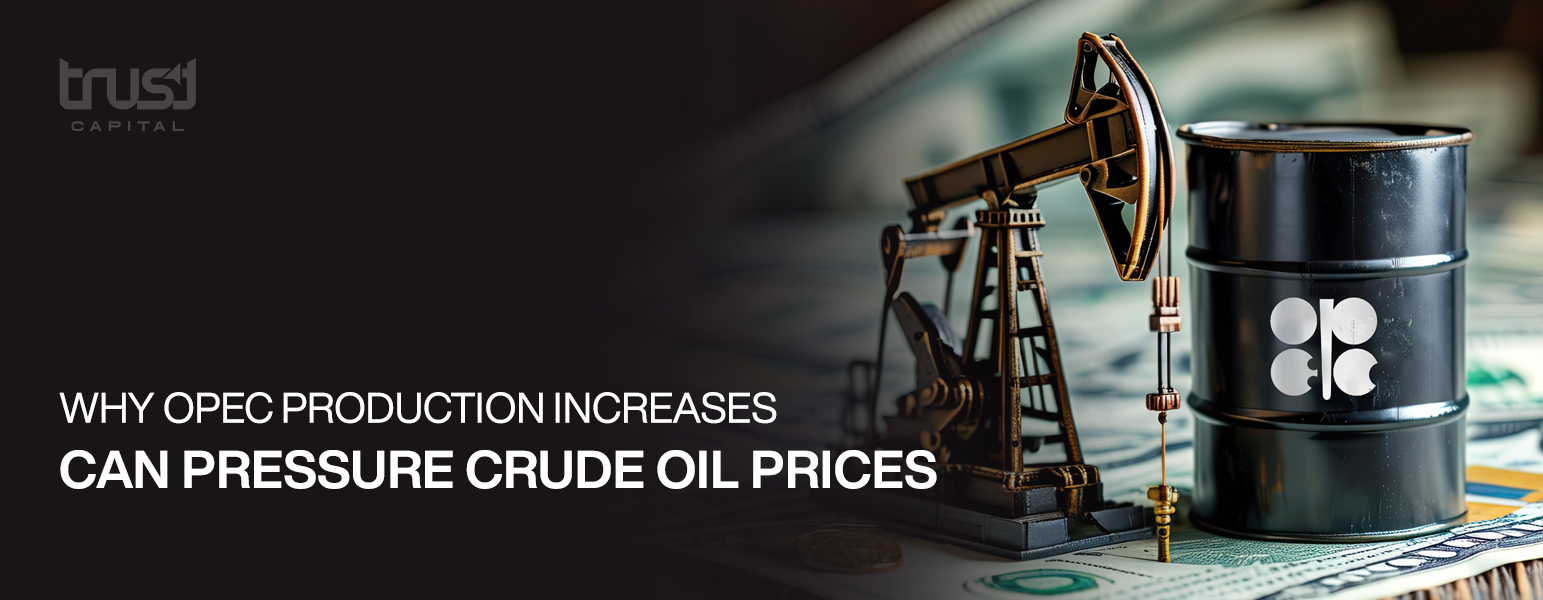
Production increases can have the opposite effect. When OPEC+ participants agree to raise output, traders assess whether additional barrels will improve market availability or create an oversupply risk.
If demand is strong enough to absorb the extra production, prices may remain stable or even increase. However, if supply grows faster than consumption, oil inventories may rise and prices may come under pressure.
For example, imagine that global consumption is increasing by 500,000 barrels per day while producers collectively add 1 million barrels per day of additional supply. Assuming other factors remain unchanged, this difference could create a surplus of approximately 500,000 barrels per day.
Over time, a persistent surplus can increase inventories and weaken prices.
There are important limitations to this example. Announced production targets do not always translate into actual production, and some countries may lack the capacity to deliver their full allocations. Transportation disruptions, sanctions, infrastructure problems, and export restrictions can also prevent additional output from reaching buyers.
Consequently, traders monitor both official announcements and actual production data when assessing top oil supply trends.
4. OPEC Oil Supply in 2026: What Should Investors Watch?
The outlook for OPEC oil supply in 2026 depends on production policy, compliance with agreed targets, actual output, and the balance between global consumption and available supply.
OPEC+ has continued reviewing market conditions and adjusting its approach to production. In its October 2026 announcement, the organization reaffirmed its commitment to market stability and highlighted the importance of protecting international maritime routes, as disruptions and higher shipping and insurance costs can affect the movement of crude oil and petroleum products.
Market participants should focus on several key developments when evaluating OPEC oil supply 2026.
Production targets versus actual output
An announced increase in production does not automatically mean that the same amount of additional oil will reach the market. Traders need to assess whether participating countries can meet their targets and whether export infrastructure is operating normally.
Compliance with production agreements
The effectiveness of coordinated production policy depends partly on whether participating countries follow their agreed targets. Overproduction by some members can reduce the overall impact of planned cuts.
Changes in demand forecasts
If economic activity slows or fuel consumption weakens, additional supply may create downward pressure on prices. Stronger-than-expected demand can have the opposite effect.
Non-OPEC production growth
Oil output from countries outside OPEC+, including the United States, Canada, Brazil, and Argentina, can influence how much control the alliance has over the market balance.
Geopolitical and transportation risks
Conflicts, sanctions, shipping disruptions, and threats to major export routes can restrict the availability of oil even when producers maintain or increase output.
Together, these factors help explain the OPEC market impact 2026 and why investors should evaluate physical supply conditions rather than relying solely on production headlines.
5. The Relationship Between Oil Supply, Demand, and Prices
The fundamental principle behind oil pricing is the balance between supply and demand. OPEC decisions matter because they can alter one side of this equation, but demand remains equally important.
|
Market condition |
Potential impact on oil prices |
|
Production cuts and strong demand |
Upward pressure |
|
Production increases and weak demand |
Downward pressure |
|
Low inventories and supply disruptions |
Upward pressure |
|
Rising inventories and excess supply |
Downward pressure |
|
Strong economic growth |
Potentially higher demand and prices |
|
Economic slowdown |
Potentially weaker demand and prices |
These relationships are not automatic. Oil prices also reflect expectations about future conditions, so a price move may occur before a production adjustment takes effect.
For example, prices could fall following an announced production increase if traders had already expected a larger increase. Similarly, prices may rise after a production cut that is smaller than anticipated if the market had expected no action at all.
This makes it essential to consider both the actual decision and how it compares with market expectations.
6. The Most Important OPEC Market Developments to Follow
Investors and traders who want to understand the top OPEC supply trends should monitor a combination of official announcements, production statistics, inventory reports, and demand forecasts.
Monthly OPEC reports
OPEC's Monthly Oil Market Report provides information on production, supply, demand, and market conditions. These reports help analysts evaluate whether the oil market is becoming tighter or more oversupplied.
OPEC+ meetings
Meetings can provide important signals about future production policy. Traders often pay attention to whether the group maintains existing targets, announces additional cuts, or agrees to increase output.
Global oil inventories
Inventory data can reveal whether supply is keeping pace with consumption. Persistent inventory declines may indicate tightening conditions, while sustained increases can suggest that supply is exceeding demand.
U.S. crude oil inventory reports
Reports from the U.S. Energy Information Administration (EIA) provide information about American crude stocks, refinery activity, and petroleum demand. These figures can influence WTI prices and broader market sentiment.
Geopolitical developments
Conflicts and restrictions affecting major producing or exporting regions can disrupt oil flows and create sharp price movements. Even when production levels remain unchanged, uncertainty about transportation routes can increase market volatility.
Following these developments helps readers identify the best OPEC market news and distinguish between short-term headlines and changes that could affect the market over a longer period.
7. How Geopolitical Events Change the OPEC Oil Price Impact
Geopolitical developments can significantly alter the relationship between OPEC production decisions and global oil prices.
A production increase would normally be expected to improve supply availability. However, if a conflict disrupts exports from a major oil-producing region, the additional production may not be enough to offset the lost barrels.
Similarly, shipping restrictions or threats to important maritime routes can increase freight costs, insurance premiums, and delivery times. These expenses can raise the cost of getting crude oil to buyers, even when production itself remains stable.
The Strait of Hormuz is particularly important because it is a major route for international oil shipments. Disruptions affecting this corridor can create concerns about the availability of oil from the Gulf region.
In such situations, the market may add a geopolitical risk premium to crude oil prices. This premium reflects uncertainty about future supply rather than simply the amount of oil currently being produced.
Geopolitical events can therefore amplify or offset the effects of OPEC decisions. For traders, understanding both factors is essential when evaluating sudden changes in Brent and WTI prices.
8. What Could Influence Crude Oil Prices in 2026?
The outlook for crude oil prices 2026 will depend on the interaction between production decisions, demand expectations, inventory levels, and geopolitical developments. No single factor can reliably determine the direction of oil prices throughout the year.
OPEC's October 2026 outlook developments deserve particular attention. Reuters reported on October 12 that OPEC had reduced its forecast for global oil demand growth in 2026 to 400,000 barrels per day, down from its previous estimate of 1.4 million barrels per day. This revision highlights the importance of monitoring demand assumptions alongside production policy.
Several broad scenarios may shape the market.
Scenario 1: Tighter supply supports prices
If OPEC+ maintains restrictive production policies, inventories decline, and demand remain resilient, Brent and WTI could receive upward support. Supply disruptions could strengthen this effect.
Scenario 2: Rising production weighs on prices
If participating producers increase output while demand growth remains weak, the market could face a surplus. Higher inventories and greater competition among suppliers may then pressure crude prices.
Scenario 3: Volatility increases without a clear trend
If production policy, demand forecasts, and geopolitical conditions send conflicting signals, oil prices may experience sharp movements in both directions. Traders may react strongly to each new report or policy announcement.
These scenarios are frameworks for evaluating market conditions, not guaranteed price predictions. Actual outcomes will depend on new data and developments throughout the year.
For a more reliable oil price forecast 2026, investors should compare OPEC projections with reports from the International Energy Agency (IEA), the EIA, and other credible energy-market sources.
9. How Traders Can Use OPEC News When Trading Oil
OPEC announcements are particularly relevant for traders following Brent crude and WTI futures, contracts for difference (CFDs), and other energy-related instruments.
However, trading decisions should not be based on production headlines alone.
Monitor expectations before announcements. A decision may already be reflected in market prices. Understanding what analysts expect can help explain why prices sometimes move in the opposite direction to the headline.
Check the actual supply-demand balance. Compare production decisions with demand forecasts, inventories, and output from non-OPEC producers.
Watch volatility around major events. Oil prices can move rapidly when an announcement surprises the market. Spreads may widen, liquidity may decline, and stop-loss orders may execute at different prices from those expected.
Use risk management. Traders should define acceptable risk before entering a position, avoid excessive leverage, and consider the possibility of sharp price gaps.
Confirm the trend with price action. Technical analysis can help traders assess whether a fundamental development is being supported by market momentum or whether prices are struggling to sustain a move.
Combining fundamental research with technical analysis can provide a more balanced approach to understanding the OPEC oil price impact.
10. Common Mistakes When Interpreting OPEC Decisions
Even experienced market participants can misread OPEC announcements if they focus on only one part of the market.
Assuming every production cut will raise prices: Weak demand or rising production elsewhere can offset a reduction in OPEC+ supply.
Ignoring compliance: Announced targets and actual production may differ, affecting the quantity of oil that reaches the market.
Overlooking demand forecasts: A supply reduction may have limited effect if consumption is falling more quickly.
Ignoring geopolitical risks: Shipping disruptions and export restrictions can change market conditions independently of production targets.
Treating forecasts as guarantees: Analyst projections and official estimates depend on assumptions that can change as new information becomes available.
Avoiding these mistakes can help readers develop a more accurate understanding of global oil markets and the forces behind changing prices.
Frequently Asked Questions (FAQs)
1. How do OPEC decisions affect global oil prices?
OPEC decisions can influence global oil prices by changing production targets and expectations about future supply. Production cuts may support prices when demand is stable, while production increases may put pressure on prices if supply exceeds consumption.
2. What happens to oil prices when OPEC cuts production?
Oil prices may rise when production cuts reduce available supply, particularly if inventories are low and demand remains strong. However, the impact depends on compliance, demand conditions, and production from other countries.
3. Can OPEC control global crude oil prices?
OPEC can influence the oil market, but it cannot completely control global prices. Non-OPEC production, economic growth, inventories, geopolitical risks, and changes in consumer demand also play important roles.
4. What should investors watch in the OPEC oil market in 2026?
Investors should monitor production targets, actual output, demand forecasts, inventory reports, OPEC+ meetings, and geopolitical developments. Comparing multiple sources can provide a more complete view of market conditions.
5. What factors could influence the oil price forecast for 2026?
The outlook depends on the balance between global supply and demand, OPEC+ production decisions, output from non-OPEC producers, inventory levels, economic growth, and disruptions to oil transportation.
6. Why do oil prices sometimes fall after an OPEC production cut?
Prices can fall if the cut is smaller than expected, demand forecasts deteriorate, other producers increase output, or traders have already priced in the announcement. Market reactions depend on new information relative to existing expectations.
Conclusion: Understanding OPEC's Influence on the Future of Oil Prices
OPEC remains an important influence on global oil markets because its production decisions can change supply expectations and affect the balance between available crude oil and global consumption. Production cuts may tighten the market, while production increases can ease supply pressures, but the final effect depends on demand, inventories, non-OPEC output, and geopolitical developments.
In 2026, monitoring production policy alongside changing demand forecasts is particularly important for understanding the direction of the energy market. Traders and investors should follow official OPEC reports, OPEC+ announcements, inventory data, and broader economic developments rather than relying on a single headline.
By understanding these relationships, readers can better evaluate best global oil trends, recognize significant market changes, and assess the factors that may influence best global oil prices and the broader crude oil outlook.
Ultimately, successful oil-market analysis requires a combination of reliable data, careful interpretation, and disciplined risk management. OPEC decisions provide an important piece of the picture, but a complete assessment must consider the entire global energy market.